MarketingGuide
HighLevel White Label and SaaS Reselling: How It Works and What It Costs (2026)
How HighLevel white labeling and SaaS Mode reselling work: branded desktop domain, mobile app add-on, rebilling with and without markup, which plan you need, and the real costs.


“HighLevel white label” gets used for three different things, and agencies lose money when they mix them up. The first is branding: clients log in to a dashboard on your domain with your logo instead of HighLevel’s. The second is rebilling: you pass SMS, phone, email, and AI usage costs through to each client, either at cost or with a margin. The third is SaaS reselling: you sell your own software subscription, with your own plans and prices, built on HighLevel. Each one depends on a different plan tier and carries different costs. This guide separates the three, shows which HighLevel plan unlocks each layer, and lays out the setup work and fees agencies tend to underestimate. If you are still deciding whether HighLevel fits your agency at all, start with our HighLevel review.
The three layers of HighLevel white labeling
| Layer | What the client sees or pays | Minimum plan (published) | Extra cost |
|---|---|---|---|
| Branded dashboard | Your domain, logo, and colors on the desktop web app | Starter ($97/month) | Your own domain only |
| Rebilling at cost | Usage charges (SMS, calls, email, AI) billed to the client at HighLevel’s price | Unlimited ($297/month) | None beyond usage |
| Rebilling with markup + SaaS Mode | Your own subscription plans, plus usage billed with your margin | Agency Pro ($497/month) | Payment processing on your Stripe account |
| Branded mobile app | An iOS/Android app under your brand name | Optional add-on | Listed at $497/month on the pricing page |
Plan prices are from HighLevel’s official pricing page as verified on September 7, 2026 and rechecked on October 26, 2026; annual billing is $970, $2,970, and $4,970 per year respectively. Confirm current figures on HighLevel’s pricing page before you quote anything to a client.
Layer 1: the branded desktop dashboard
Every plan lets you present the web app under your own brand. HighLevel’s help center describes the setup as a subdomain such as app.youragency.com: you create a CNAME record at your DNS provider, then enter the subdomain in the agency’s company settings under the white-label section. After that, clients log in at your URL and see your logo rather than HighLevel’s.
Two details catch new agencies out:
- The login domain is not the only domain. HighLevel uses a separate “API domain” for branded links inside emails and SMS. If you only set up the login domain, tracked links in client messages can still show a HighLevel-owned host. The help center also covers separate domains for email sending, sites, and the client portal. Plan for four or five DNS records, not one.
- Desktop app branding is a separate step. HighLevel offers a desktop app customizer (theme, icon, app name, login screen) for macOS, Windows, and Linux builds. It is optional, but if you promise clients “your own software,” the customizer is what makes the installed app match.
Branding is the cheapest layer and the one most clients notice. It is also the only layer you need if you sell a done-for-you service and simply want the dashboard to look like part of your retainer.
Layer 2: rebilling usage at cost (Unlimited)
HighLevel charges usage separately from the subscription: SMS, phone minutes, email sends through its LC Email service, and AI features all draw from a prepaid wallet. Without rebilling, your agency wallet pays for every client’s usage and you recover it manually, or not at all.
According to HighLevel’s help article on rebilling and wallets, rebilling without markup is available on the $297 Unlimited plan and above. HighLevel charges your agency wallet first, then charges the sub-account the same amount for the usage it generated. Three operating details matter:
- Rebilling is switched on per sub-account. Existing sub-accounts need it enabled manually from the agency view. Sub-accounts created later through the SaaS configurator can inherit it automatically.
- The client needs a payment method on file. If rebilling is enabled but the sub-account has no card, rebilling stays on hold and access may be restricted until payment is set up.
- At-cost rebilling earns nothing. It protects your margin on the retainer; it does not create new margin.
For most service agencies, Unlimited plus at-cost rebilling is the practical ceiling. You charge a retainer for the work, clients pay their own messaging costs, and you avoid becoming a software vendor with billing support obligations.
Layer 3: SaaS Mode and rebilling with markup (Agency Pro)
SaaS Mode is HighLevel’s term for running a software business on top of the platform. It is part of the $497/month Agency Pro plan. HighLevel’s SaaS Mode page describes the workflow as: build your plans, set pricing, set a trial, add phone credits, attach snapshots, and choose your rebilling margin.
What that means in practice:
- You define your own subscription plans. For example, a “Starter” plan for local businesses at a price you choose, with specific features enabled. Clients sign up and pay your Stripe account, and HighLevel provisions a sub-account automatically.
- Snapshots preload each new account. A snapshot is a saved template of funnels, workflows, pipelines, calendars, and settings. Attaching one to a plan means every new client starts with your configured system instead of a blank workspace.
- Usage can carry your margin. The help center states that rebilling with agency markup is available on Agency Pro and is part of SaaS Mode; the agency keeps the difference between HighLevel’s cost and its marked-up price. The margin is set per sub-account or in the SaaS configurator.
The upside is recurring software revenue that does not scale with your team’s hours. The cost is that you now own the customer relationship for software: onboarding, churn, failed payments, and “why did my SMS bill go up” tickets.
What reselling looks like inside HighLevel
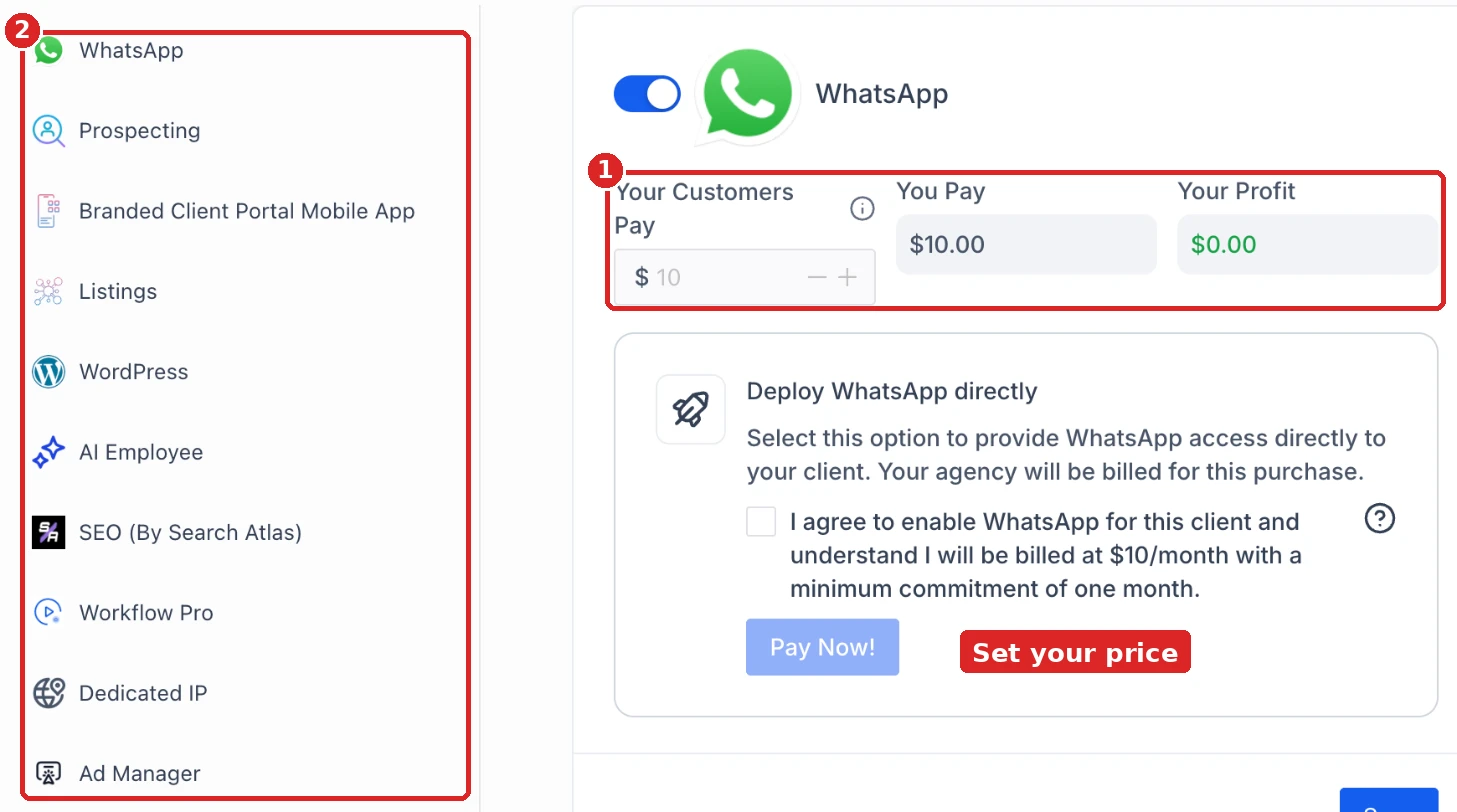
In our November 2026 Starter trial, each client sub-account had a Reselling tab listing add-ons the agency can offer: WhatsApp, Prospecting, the Branded Client Portal Mobile App, Listings, WordPress hosting, AI Employee, SEO, Workflow Pro, Dedicated IP, and Ad Manager. For WhatsApp the screen showed the agency cost ($10.00 per month), a field for what the customer pays, and the resulting profit. Enabling it requires ticking an agreement that bills the agency, so set the client price and contract first. This per-add-on margin is separate from usage rebilling and SaaS Mode, and it was available on Starter.
The branded mobile app add-on
Clients increasingly expect to answer leads and messages on their phones. HighLevel’s standard mobile app works for sub-account users, but it carries HighLevel’s own app branding. A white-label mobile app, published under your agency’s name in the App Store and Google Play, is an optional add-on listed at $497/month on the pricing page.
The setup is heavier than the desktop branding. HighLevel’s self-service customizer documentation lists prerequisites including a D-U-N-S number (an Apple requirement), an Apple Developer Program organization account, and a Google Play Console organization account. Apple individual developer accounts are not supported for white-label publishing. Budget several weeks for business verification before the app can ship.
For most agencies, the branded app only makes sense once you have enough SaaS clients that the add-on is a small share of revenue.
Which plan do you actually need?
| Your business model | Plan | Why |
|---|---|---|
| Up to three clients, branded dashboard is enough | Starter ($97/mo) | Branding works on every plan; three sub-accounts |
| Service retainers, many clients, pass-through usage | Unlimited ($297/mo) | Unlimited sub-accounts and at-cost rebilling |
| Selling your own software subscriptions | Agency Pro ($497/mo) | SaaS Mode, automated provisioning, markup on usage |
| Fully branded mobile experience | Any plan + app add-on | Listed at $497/mo; organization developer accounts required |
A useful test: if you cannot name a monthly price, a target customer, and an onboarding snapshot for your SaaS offer, you are not ready for Agency Pro yet. Start on Unlimited, rebill at cost, and upgrade when the SaaS plan is designed.
A simple break-even check for SaaS Mode
Agency Pro costs $200/month more than Unlimited at published monthly rates. Suppose you sell a $97/month SaaS plan to local businesses. Before payment processing, two paying SaaS clients cover the upgrade; everything after that is gross margin, minus your usage costs and support time. If you sell a $297/month plan with done-for-you onboarding, a single client covers it.
Do not treat this as a profit forecast. Churn, refunds, support load, and processing fees all reduce the margin, and your first SaaS clients usually need more hand-holding than retainer clients. For the full decision (where margin really comes from, and when selling software is the wrong move), read is HighLevel white-label SaaS reselling worth it?. This guide stays focused on how the setup works and what it costs.
Common mistakes
- Promising “your own software” on Starter. Branding works, but provisioning, plan billing, and markup do not exist below Agency Pro.
- Skipping the API domain. Branded logins with HighLevel-hosted tracking links undermine the white-label promise.
- Turning on rebilling without payment methods. Sub-accounts without a card go on hold, which looks like an outage to the client.
- Pricing SaaS plans before modeling usage. SMS-heavy niches (home services, dental reminders) can consume most of a low-priced plan in usage if you do not mark it up.
- Underestimating mobile app paperwork. D-U-N-S and organization developer accounts take time; do not promise a launch date until they are approved.
How this compares with alternatives
If white labeling is the main requirement, HighLevel’s combination of branded dashboard, sub-accounts, and SaaS Mode is unusual at its price point. Tools like HubSpot or ActiveCampaign are strong CRMs and automation platforms, but they are built to be used under their own brand, not resold. If you mainly need a funnel builder and email for one business rather than client accounts, Systeme.io is far cheaper. For a broader shortlist, see best HighLevel alternatives and our HighLevel for marketing agencies guide.
Start a HighLevel 14-day trial and set up the branded domain during the trial, so you can see exactly what your clients would see before you commit to a plan.
FAQ
Is HighLevel white label available on the Starter plan?
Yes, for the dashboard. Every plan supports a branded login domain and your logo. What Starter lacks is scale and billing: it includes three sub-accounts and no rebilling. Rebilling at cost starts on Unlimited, and SaaS Mode with markup requires Agency Pro.
Do I need Agency Pro to resell HighLevel?
You need Agency Pro to resell it as your own software subscription with automated sign-up and marked-up usage. Many agencies “resell” HighLevel informally by bundling it into a service retainer on Unlimited. That works, but you handle billing yourself and cannot mark up usage through the platform.
How much does the HighLevel white-label mobile app cost?
The official pricing page lists the white-label mobile app as an optional add-on at $497 per month. You also need an Apple Developer organization account, a Google Play Console organization account, and a D-U-N-S number before the app can be published.
Will clients ever see the HighLevel name?
With the login domain, API domain, and desktop customizer configured, the day-to-day experience is under your brand. The main exception is mobile: the standard mobile app carries HighLevel’s own branding unless you add the white-label app. Test every client-facing touchpoint during the trial rather than assuming full coverage.
Can I switch from Unlimited to Agency Pro later?
HighLevel states that you can upgrade from the dashboard, with prorated charges when upgrading mid-cycle. Starting on Unlimited and upgrading once your SaaS offer is defined is a common and lower-risk path.
Confirm plan inclusions and add-on prices on HighLevel’s pricing page before quoting clients. Visit HighLevel to start a trial on the tier that matches your reselling model.