MarketingReview
Systeme.io Review (2026): Features, Pricing, Pros and Cons, and Who It's For
An independent Systeme.io review: what the funnel, email, automation, course, community, and affiliate tools actually include, 2026 pricing and free plan limits, honest pros and cons, common complaints, and who should pick it or skip it.

Systeme.io is an all-in-one platform for solo creators, coaches, course sellers, and affiliate marketers. In one account it bundles sales funnels, email marketing, automation, online courses, communities, a booking calendar, a website and blog, a CRM pipeline, and a tool for running your own affiliate program. The free plan covers 2,000 contacts with unlimited email sends, and paid plans start at $17 per month. Our verdict: for a solo business under 5,000 contacts that wants one login instead of four subscriptions, Systeme.io is the best value in its category. It is the wrong choice if you need pixel-level page design, deep email automation, or agency-grade client management. This Systeme.io review explains what each tool includes, what the plans cost, where the platform falls short, what users complain about, and how to test it on the free plan before you pay. We opened a free Systeme.io account on November 20, 2026, built a test funnel and course, and checked every feature and price against the official pages the same day. We did not pay for an upgrade; where a claim comes from user reports rather than our own test or official documentation, we say so.
Systeme.io at a glance
| Best for | Solo creators, coaches, course sellers, and affiliate marketers selling digital products |
| Not ideal for | Design-heavy brands, complex e-commerce, advanced email marketers, multi-client agencies |
| Free plan | Yes: 2,000 contacts, 3 funnels, 1 course, unlimited emails, no credit card |
| Paid plans | Startup $17, Webinar $47, Unlimited $97 per month; annual billing is two months free |
| Transaction fees | 0% on every plan (payment processor fees still apply) |
| Replaces | A funnel builder, an email tool, a course host, a scheduler, and an affiliate tracker |
How we evaluated Systeme.io
We signed up for a free Systeme.io account on November 20, 2026, and used it to test the parts of the platform a new user touches first. All test items were named “Athanor test” so they are easy to identify:
- Created an opt-in funnel from the “Build an audience” goal and opened the page editor.
- Tried to create an email campaign (automated sequence).
- Opened the automation rule builder and its trigger list.
- Created a course, added a module, and opened the lecture settings.
- Read the in-app My plan page, which shows live usage against every limit.
We did not publish pages, send emails, connect a payment processor, or upgrade to a paid plan, so checkout, deliverability, and paid-plan features are based on documentation. We also read Systeme.io’s features page, pricing page, compare table, and both pages’ FAQs on the same day. We then checked each feature against the job a solo business needs it to do (capture a lead, sell an offer, deliver a course, follow up by email) and compared the limits with specialist tools we cover elsewhere on Athanor. For the weaknesses, we also looked at recurring themes in public user reviews on sites such as Trustpilot and Capterra. Those reports are individual opinions, so we treat them as signals to test, not as verified facts.
Features: what you get in one account
Systeme.io’s central pitch is consolidation. Every tool below shares one contact list, so an opt-in, a purchase, or a course enrollment can tag a contact and trigger the next step without Zapier. Most features are available on every plan, including Free; paid plans raise the limits. The exception is evergreen webinars, which start on the Webinar plan.
Sales funnels
Creating a funnel starts with a goal (build an audience, sell, run an evergreen webinar, or custom). In our test, choosing “Build an audience” immediately created an opt-in page and a thank-you page with a template applied, so there is something to edit within seconds. The funnel builder uses a drag-and-drop editor and templates for opt-in, sales, webinar, and launch funnels. It includes A/B split testing, one-click upsells, order bumps, and countdown timers, and the compare table lists deadline funnels on every plan. Checkout pages connect to Stripe, PayPal, and several regional gateways. The Free plan allows 3 funnels and 15 funnel steps; Startup raises that to 10 funnels and 50 steps.
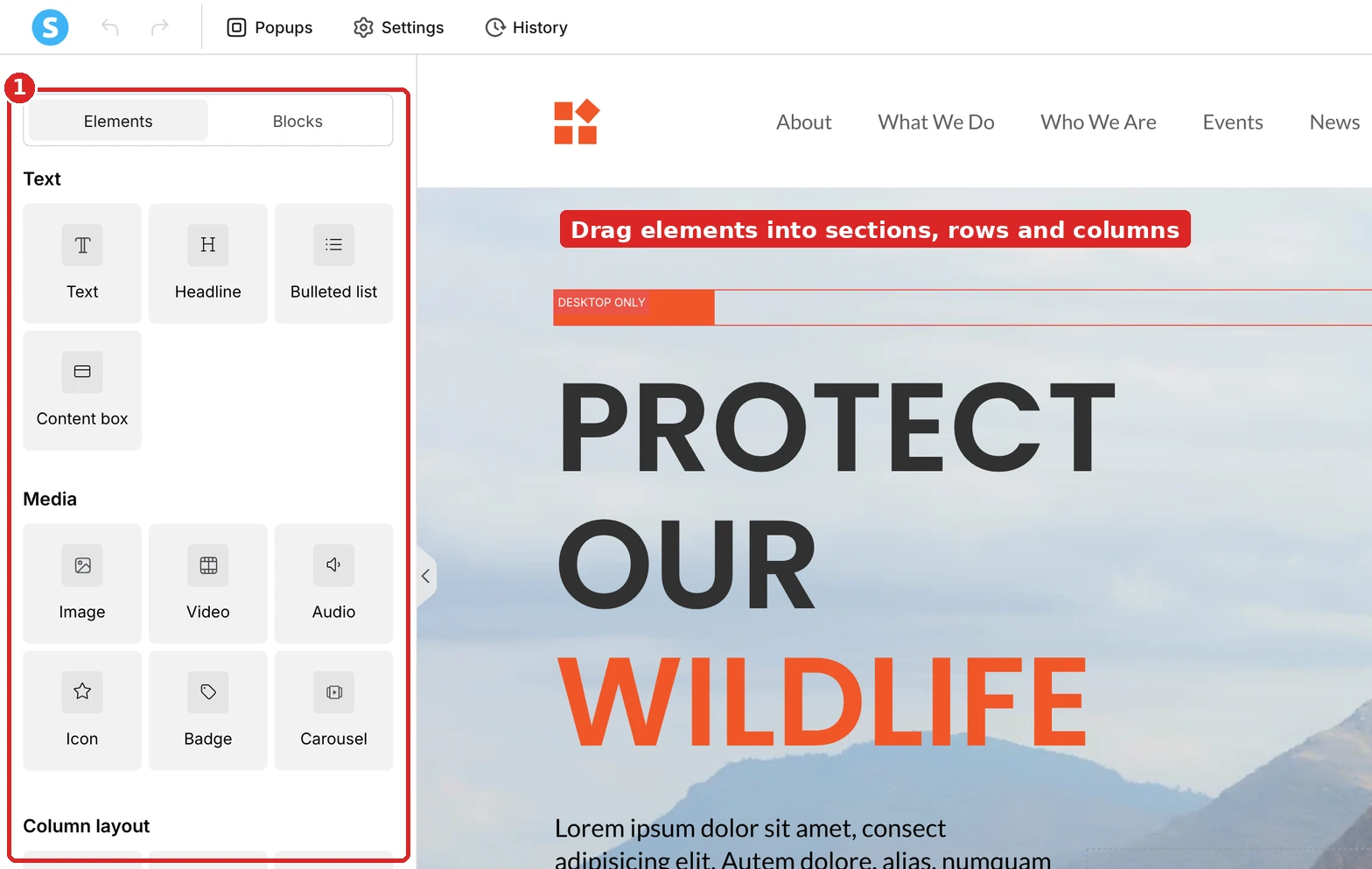
The page editor in our free test account, captured November 20, 2026.
The editor works by dragging elements (text, images, video, forms, countdowns, raw HTML) into sections, rows, and columns. That structure keeps pages tidy on mobile, but it is not a free-form canvas: you cannot drop an element at an arbitrary position the way some funnel builders allow. Several bundled templates use stock photos and lorem ipsum text, so plan to replace every image and line of copy before you publish.
Email marketing
You get broadcast newsletters, automated sequences (Systeme.io calls these “campaigns”), tags, and segmentation, with unlimited email sends on every plan. Because the list lives in the same account as your funnels and courses, a new subscriber is tagged and enrolled automatically. The limits to watch are sequences and tags: Free allows 1 campaign and 1 tag, Startup 10 of each.
One setup step surprised us. You cannot create a campaign until you add and verify a sender email address, and the account’s own login email is not offered as a sender by default.
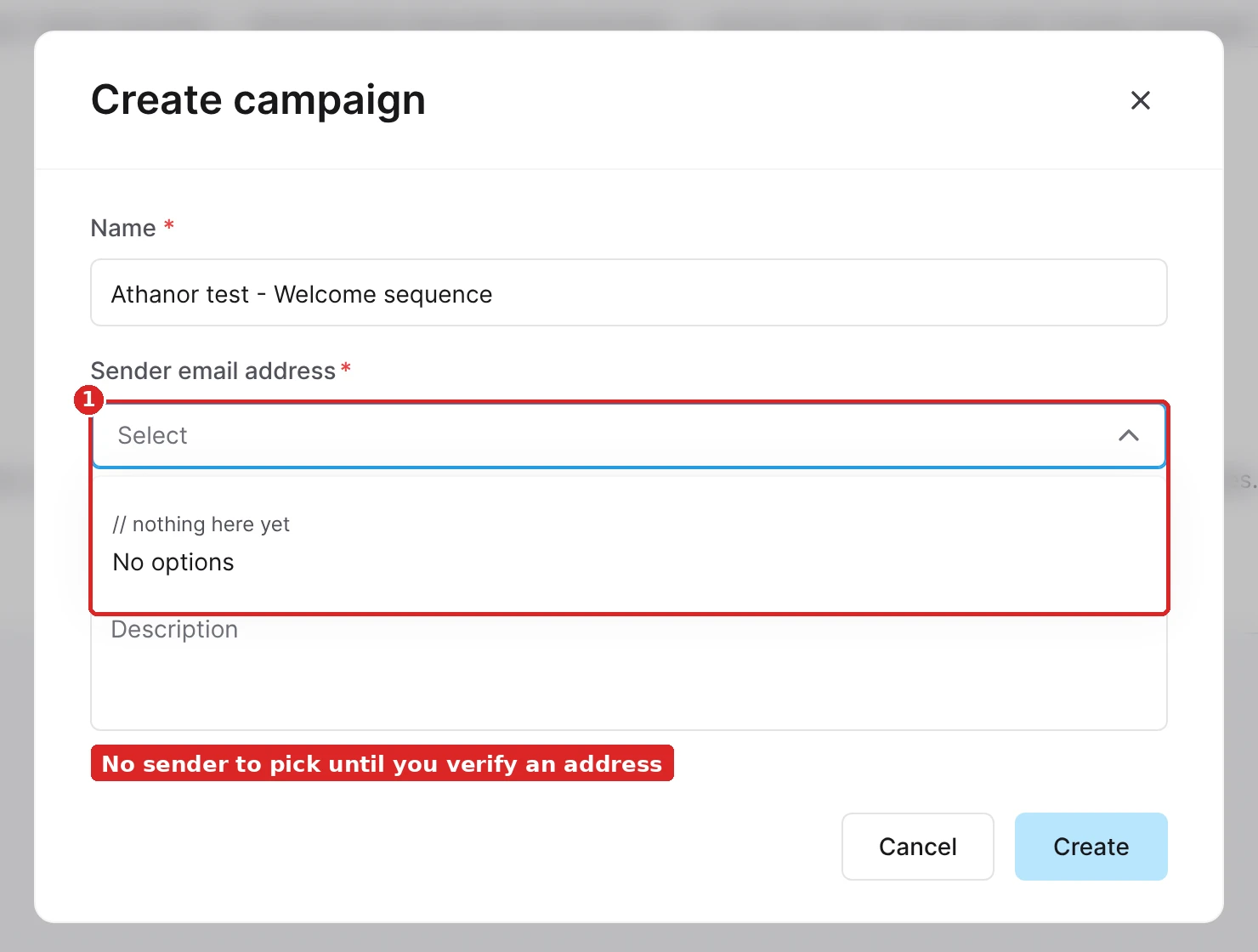
Creating a campaign in a new free account, captured November 20, 2026.
Budget a few minutes to verify a sender, and ideally authenticate your own domain, before you plan your first sequence. Newsletters and sequences can then go out with unlimited sends.
Automation rules and workflows
There are two automation tools. Automation rules are simple if-this-then-that triggers: a tag is added, a form is submitted, or a sale is made, and Systeme.io sends an email, adds a tag, or enrolls the contact in a campaign. Workflows are a visual canvas with delays and yes/no decision branches based on tags, contact fields, or email activity. In our test account, the rule builder offered triggers grouped by contact (tag added or removed), forms and subscriptions, courses (enrolled, module or course completed), sales (new sale, cancellation, failed subscription payment), email (campaign completed, email opened, link clicked), events (webinar registration, meeting scheduled), communities, and page visits.
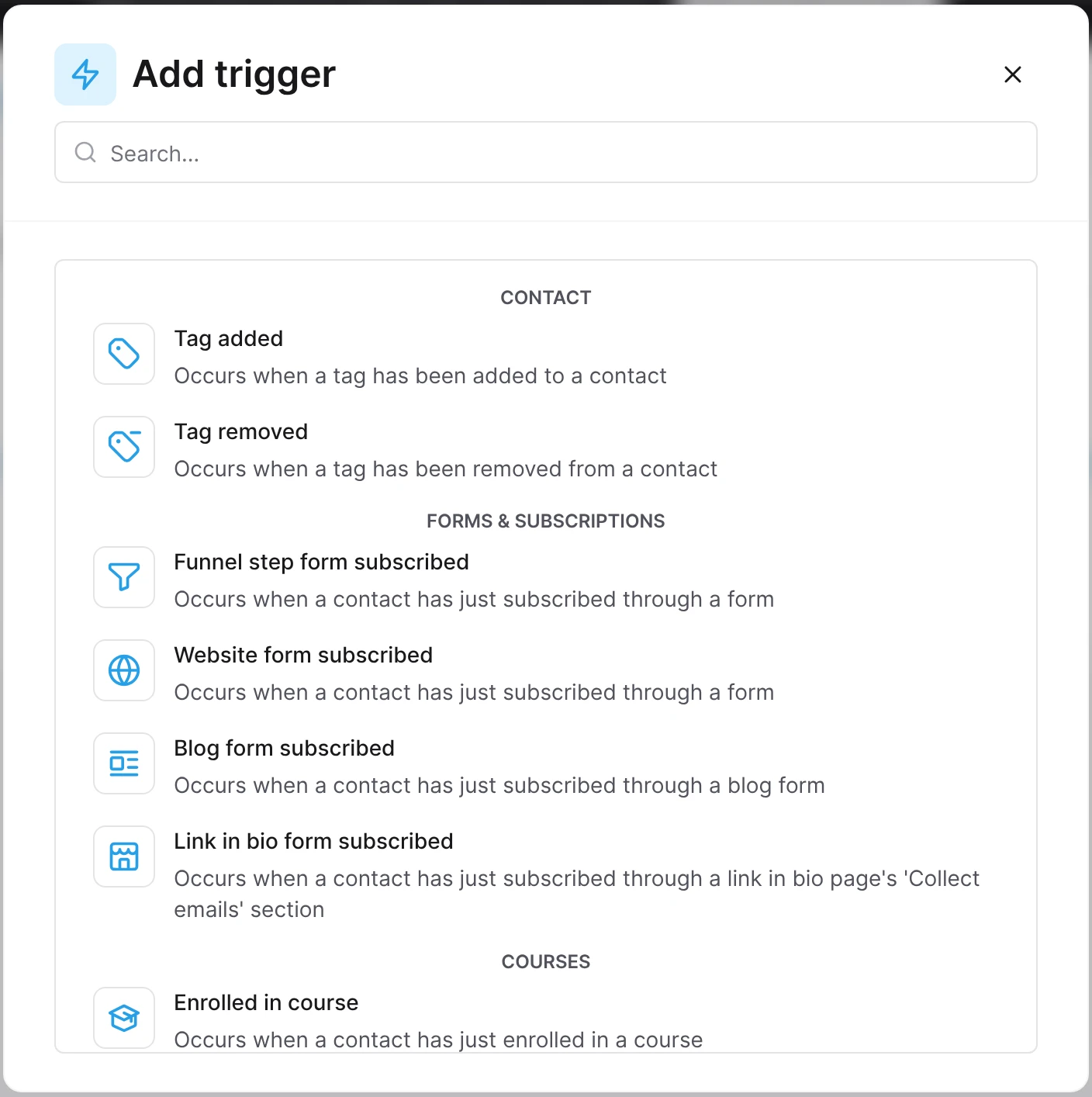
The trigger picker in the automation rule builder, captured November 20, 2026.
This covers the common creator automations well. It is not as deep as dedicated tools such as ActiveCampaign, which offer lead scoring and much richer conditional logic; see our ActiveCampaign vs Systeme.io comparison.
Online courses and communities
The course builder supports video lessons, downloadable files, drip schedules, module locking, and student progress tracking. In our test, each lecture had its own delay before unlock field for drip content and an option to allow student comments, plus a choice of lecture templates.
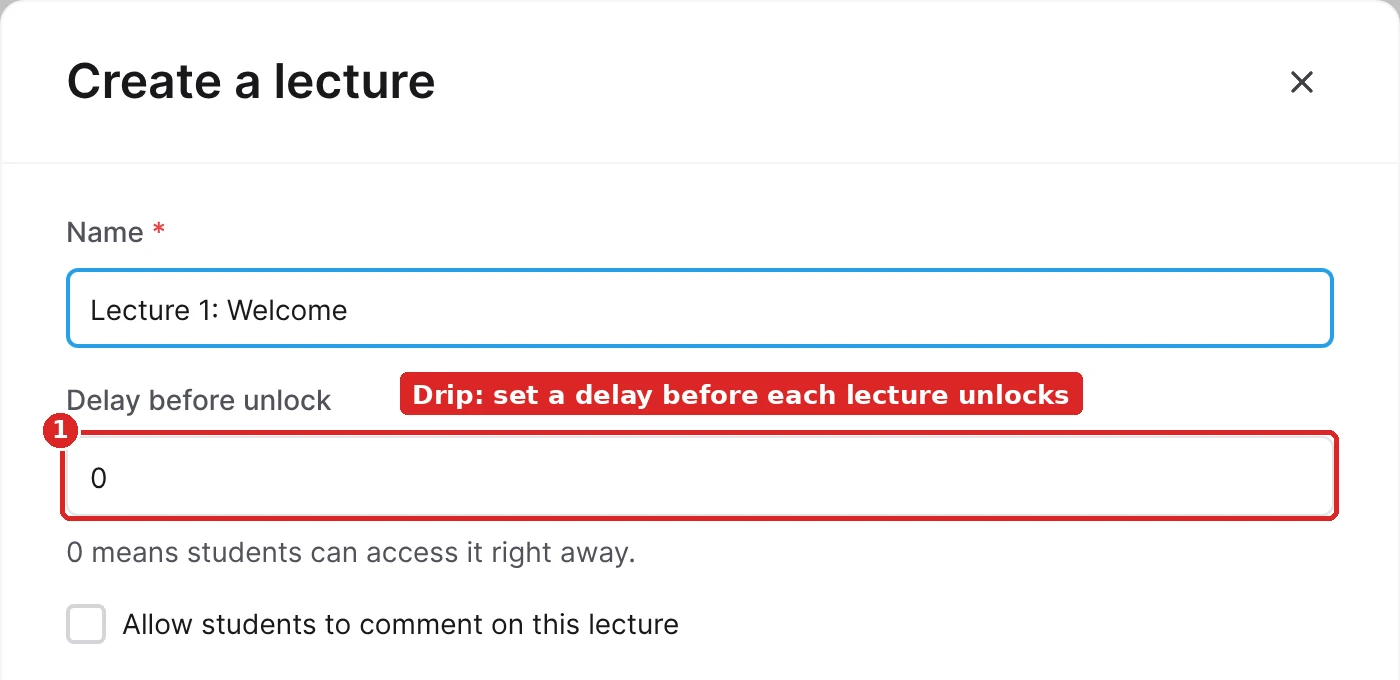
Lecture settings in a free test course, captured November 20, 2026. Courses are sold through your funnels, and access is granted automatically on purchase. Paid plans have unlimited students; Free caps students at 500 and courses at 1. Communities give you a free or paid members-only space with posts and comments, connected to the same courses and funnels. It replaces a basic Circle or Skool setup, not a large community with advanced moderation needs.
Website, blog, and link in bio
You can build a multi-page website with a blog on a custom domain, including on Free. A link-in-bio page lets social visitors buy digital products from one mobile page, similar to Stan Store or a selling Linktree. These are serviceable rather than polished: the templates are clean, but layout control is limited compared with Webflow, WordPress, or a dedicated page builder.
Booking calendar and CRM pipelines
The built-in booking calendar works like a simple Calendly. Clients pick a slot, get confirmation emails, and can pay a deposit or full fee at booking, with Google Calendar, Google Meet, and Zoom integrations. CRM pipelines are Kanban boards with custom stages that can trigger follow-up emails. These cover a coach’s sales calls, not a sales team’s CRM.
Affiliate program management
Systeme.io lets you run your own affiliate program on every plan: set commission rates, issue affiliate links, track referrals, and manage payouts. For product creators, this replaces a separate tool such as Tapfiliate, and it is one of Systeme.io’s most distinctive features at this price.
Evergreen webinars, physical products, SMS, and sub-accounts
- Evergreen webinars (Webinar plan and up) replay a recorded webinar on a schedule, with registration funnels, reminder emails, and an offer during playback.
- Physical products can be sold through funnel checkouts with variants, inventory limits, and shipping fees. Fine for a few products, not a replacement for Shopify.
- SMS messages run through the same automation builder as email, but they are sent through your own Twilio account, which you connect under Integrations and pay per message. Systeme.io itself does not sell SMS credits.
- Sub-accounts are unlimited on every plan, and Systeme.io also sells a white-label version. Agencies with many clients should still compare HighLevel vs Systeme.io.
Pricing
Systeme.io publishes four self-serve plans on its official pricing page, plus a quote-based Custom plan for teams. Every plan includes unlimited emails, unlimited file storage, the affiliate program tool, and 0% transaction fees.
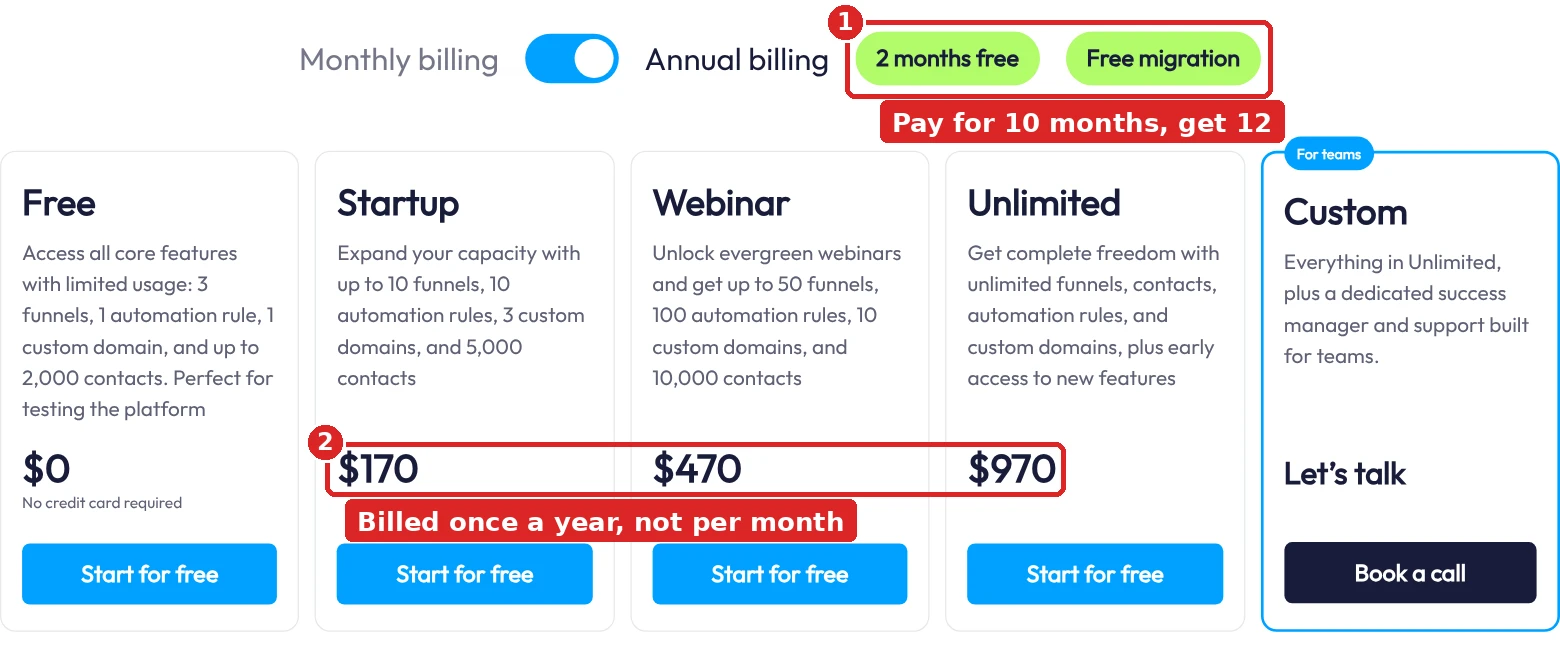
The official pricing page with annual billing selected, captured November 20, 2026. The coach marks are ours.
| Plan | Monthly | Annual | Contacts | Key limits |
|---|---|---|---|---|
| Free | $0 | $0 | 2,000 | 3 funnels, 1 campaign, 1 automation rule, 1 course (500 students) |
| Startup | $17 | $170 | 5,000 | 10 funnels, 10 campaigns, 10 rules, 5 courses |
| Webinar | $47 | $470 | 10,000 | 50 funnels, 100 campaigns, 100 rules, 20 courses, evergreen webinars |
| Unlimited | $97 | $970 | Unlimited | Unlimited everything, kickstart coaching, free migration |
The in-app My plan page is more useful than the public pricing page, because it shows your live usage against every limit. It also lists one cap the public compare table does not: on the Free plan, sales revenue is limited to $10,000. Every paid plan shows unlimited revenue.
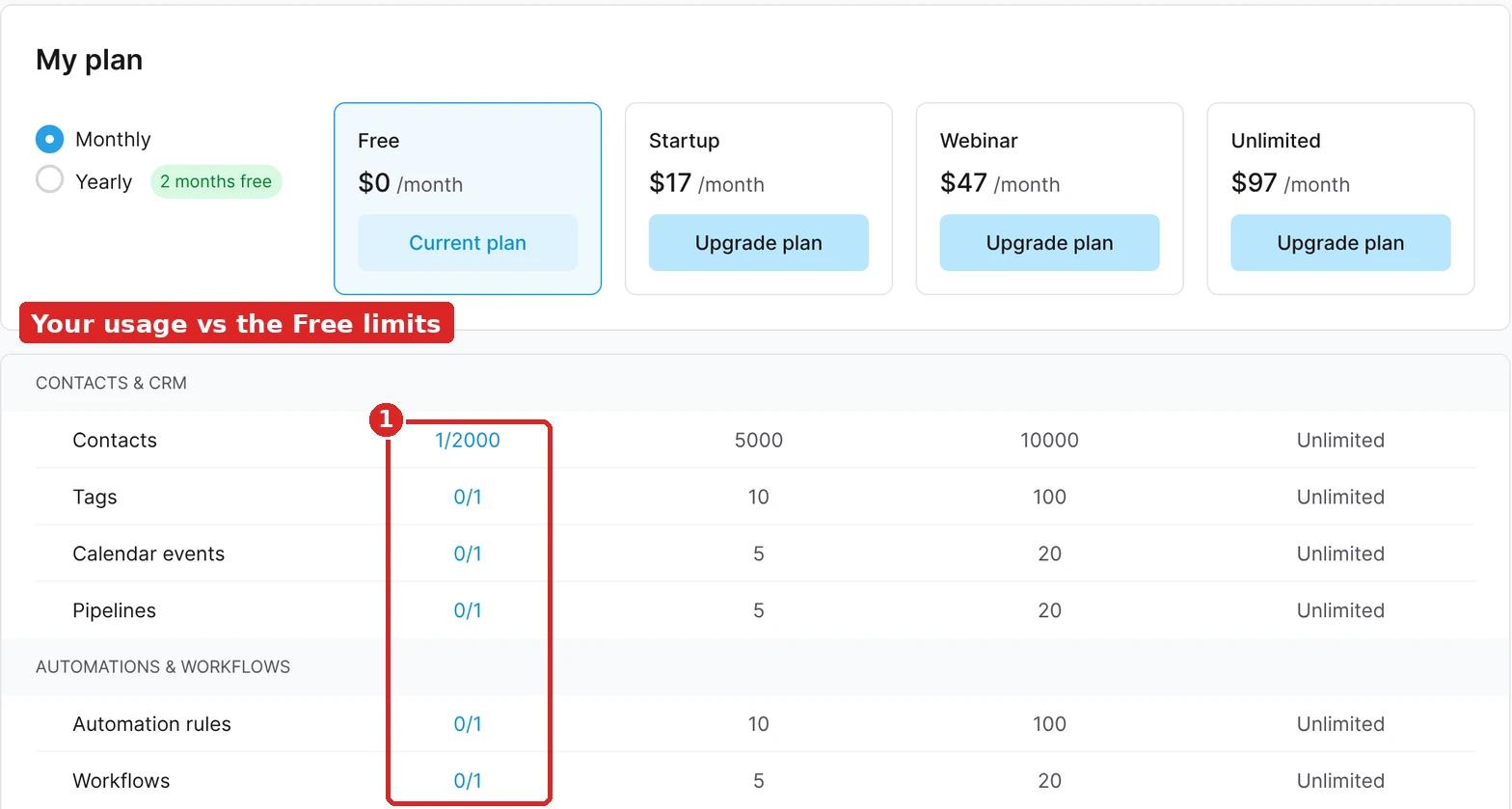
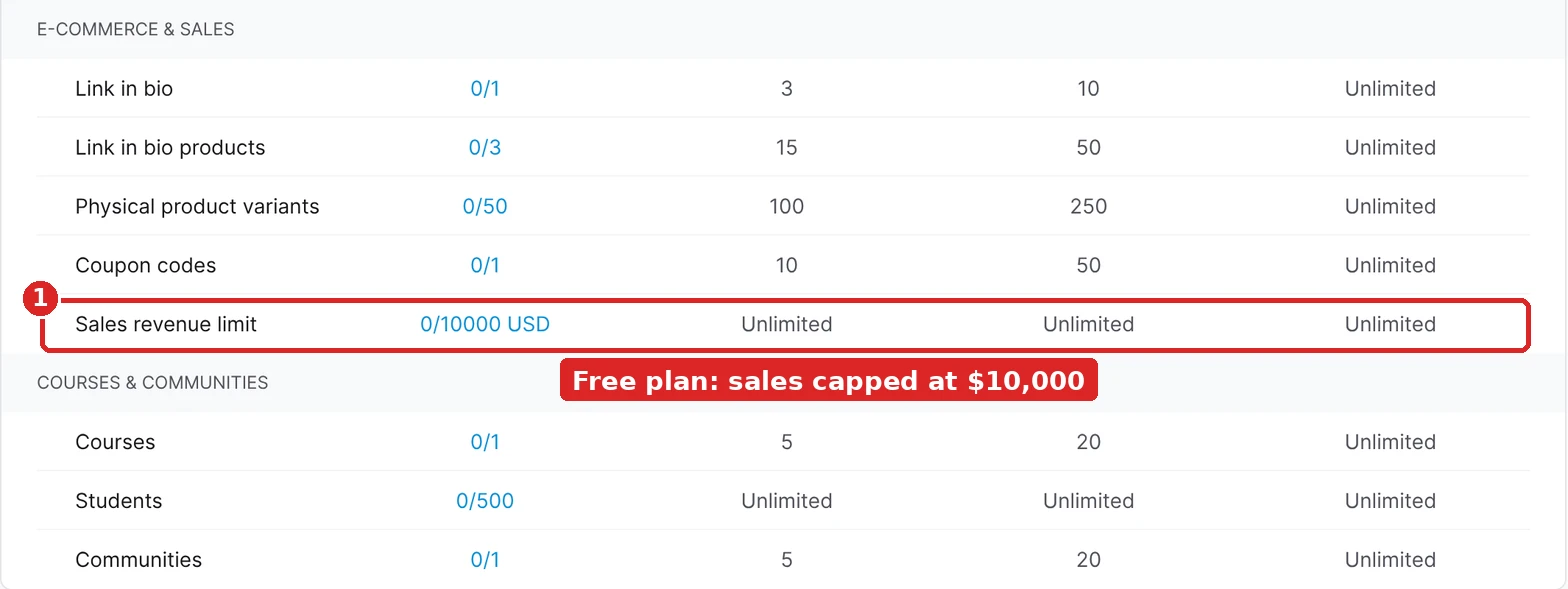
The My plan page in our free test account, captured November 20, 2026. The coach marks are ours.
On value, the comparison that matters is against a stack of separate tools, not against one competitor. A funnel builder, an email platform, and a course host bought separately usually cost several times the Startup plan. For every limit in the compare table, the annual savings, and which cap forces the first upgrade, see our full Systeme.io pricing guide. For a judgment by buyer type, read Systeme.io pricing vs value.
Start free on Systeme.io: build your first funnel and email list
Pros and cons
Pros
- Real consolidation. Funnels, email, courses, communities, bookings, and affiliates share one contact list, so automations work across tools without Zapier.
- Generous free plan. 2,000 contacts, unlimited emails, a website, a course, and a funnel set, with no time limit and no credit card.
- Low paid prices. Startup at $17 per month covers most solo businesses under 5,000 contacts.
- 0% transaction fees on every plan, unlike some funnel and course platforms that take a cut on lower tiers.
- Unlimited students and email sends on paid plans, which removes two common cost drivers.
- Built-in affiliate program, rare at this price.
- Beginner friendly. Drag-and-drop editors and templates throughout.
- Sensible account security. Logging in from a new device asked us for a code sent by email before opening the dashboard.
Cons
- Shallow individual tools. The page builder, automation, and CRM are simpler than specialist software.
- Limited design control. Pages are built from blocks and sections, with less layout freedom than ClickFunnels or Webflow.
- Short native integration list. The compare table lists Google Sheets, Google Calendar, Google Meet, Zoom, ActiveCampaign, SendGrid, and Twilio; anything else goes through the public API or a connector such as Zapier.
- Tight Free plan caps. One email campaign, one automation rule, one tag, and a $10,000 revenue limit push most active sellers to Startup quickly.
- Account review risk. Some users report blocked accounts or held email sending (see below).
Common complaints from users
Systeme.io has a high average rating on Trustpilot from several thousand reviews, and positive reviews mostly praise value, the all-in-one scope, and responsive support. The negative reviews cluster around a few themes worth knowing before you build your business on the platform:
- Account blocks and held email sending. A recurring theme in low-star reviews is accounts suspended, or email sending paused pending identity or compliance checks, sometimes without warning. All-in-one email senders protect shared sending reputation this way, but it hurts if it happens during a launch. Build your list with clear opt-ins, keep a recent export of your contacts, and avoid sending to purchased lists.
- Email deliverability. Reports are mixed. Some reviewers see good inbox placement, others see promotions-tab or spam issues. Set up your own sending domain and authenticate it before a launch.
- Builder limitations. Users who care about design often find the editor rigid and occasionally buggy.
None of these are deal-breakers for most solo creators, but they are good reasons to test on the free plan with your real domain before migrating everything.
Who Systeme.io is for
Choose Systeme.io if you are:
- A coach or consultant who needs opt-in pages, a booking calendar, a paid offer, and email follow-up in one place. See Systeme.io for coaches.
- A course creator who wants courses, a community, and sales funnels without a separate course host. Compare Systeme.io vs Kajabi and Systeme.io vs Thinkific.
- An affiliate marketer who needs bridge pages, lead magnets, and email sequences. See Systeme.io for affiliate marketers.
- A digital product seller running launches with upsells and order bumps. See Systeme.io for digital product launches.
Skip Systeme.io if you are:
- An agency managing many clients that need white-label delivery, SMS and calling, and reputation tools. HighLevel is built for that.
- A funnel specialist who wants maximum design control and conversion features. Compare Systeme.io vs ClickFunnels.
- An email-first marketer who relies on advanced segmentation, lead scoring, and complex automations. A specialist like ActiveCampaign fits better.
- An e-commerce store with a large catalog. Use a dedicated store platform such as Shopify.
How Systeme.io compares
| Platform | Starting paid price | Strength | Choose it over Systeme.io when |
|---|---|---|---|
| Systeme.io | $17/month | Breadth and price | — |
| Kajabi | Higher | Polished course and coaching experience | You want premium course delivery and branding |
| ClickFunnels | Higher | Funnel design and conversion tools | Funnels are your main revenue engine |
| HighLevel | $97/month | Agency CRM, SMS, and white label | You serve multiple clients |
| Thinkific | Higher | Course depth and learner experience | Courses are the whole business |
For more options, see the best Systeme.io alternatives for creators. Or compare the full cost of Systeme.io vs separate funnel, email, and course tools.
How to test Systeme.io before you pay
The Free plan has no time limit, so use it as a structured trial. In your first week:
- Verify a sender email and connect your own domain. Campaigns cannot be created until a sender is verified. Authenticate email sending, then send yourself a test broadcast to check inbox placement.
- Build one real funnel: opt-in page, thank-you page, and a sales page with an order bump. Check how much layout control you actually need.
- Create one email sequence and one automation rule: tag on opt-in, then enroll in the sequence. This uses the Free plan’s single campaign and rule, which shows you whether you need Startup.
- Upload one course module and walk through it as a student on mobile.
- Run a test checkout in Stripe test mode before you connect live payments.
Our Systeme.io getting started guide and funnel setup guide walk through each step.
Where to go next (creator workflows)
| Your goal | Start here |
|---|---|
| Coach or consultant funnels | Systeme.io for coaches · Funnel software for coaches and consultants |
| Digital product or launch | Systeme.io for digital product launches · How to sell digital products without a tech stack |
| Affiliate marketing beginners | How to start affiliate marketing |
| Course creators comparing stacks | Best all-in-one platform for course creators · Systeme.io vs Kajabi |
| Small business marketing bundle | Systeme.io for small business marketing |
| Plan and value fit | Systeme.io pricing · Free plan limits · Pricing vs value |
FAQ
Is Systeme.io legit?
Yes. Systeme.io is an established platform that says more than 500,000 entrepreneurs use it, and it has a high average rating from several thousand Trustpilot reviews. The main risk users report is account or email-sending suspensions during compliance checks. Use clean opt-in lists and keep a contact export to reduce that risk.
Is Systeme.io really free?
Yes. The Free plan never expires and needs no credit card. It includes 2,000 contacts, unlimited email sends, 3 funnels, 1 course with up to 500 students, a website and blog, and 1 custom domain. The tight caps are 1 email campaign, 1 automation rule, 1 tag, and a $10,000 sales revenue limit shown on the in-app plan page, so most active sellers outgrow it.
How much does Systeme.io cost?
Paid plans are Startup at $17 per month, Webinar at $47, and Unlimited at $97, or $170, $470, and $970 per year on annual billing. A quote-based Custom plan serves teams. There are no transaction fees on any plan. See our pricing guide for every limit.
Is Systeme.io good for beginners?
Yes. It is one of the easiest all-in-one platforms to start with, because the funnel, email, and course editors are drag-and-drop with templates, and everything shares one contact list. Beginners trade away design flexibility and advanced automation, which most first launches do not need.
Is Systeme.io better than ClickFunnels?
It is much cheaper and includes courses, communities, and an affiliate program on every plan. ClickFunnels offers a more polished funnel builder and conversion tooling. If funnels are your main revenue engine and design matters, compare both in our Systeme.io vs ClickFunnels review.
Can Systeme.io replace Mailchimp or ConvertKit?
For most solo creators, yes. It offers broadcasts, sequences, tags, and automations with unlimited sends on every plan, and your list is already connected to your funnels and courses. Email-first businesses that rely on advanced segmentation, deliverability tooling, or detailed reporting will find a specialist email platform stronger.
Final verdict
Systeme.io does what it promises: it replaces a funnel builder, an email tool, a course host, a scheduler, and an affiliate tracker with one account that costs $0 to start and $17 per month for most solo businesses. The trade-off is depth. Every individual tool is simpler than the specialist it replaces, and design control is limited. If your priority is launching and selling quickly on a small budget, that trade-off is worth it. If you run an agency, a design-led brand, or an email-heavy operation, look at the alternatives above first. Either way, start on the free plan, build one real funnel on your own domain, and upgrade only when a limit actually blocks you. Check current limits on the official pricing page before you buy.
Try Systeme.io free: test funnels, email, and checkout on one account