MarketingGuide
Systeme.io Free Plan Limits (2026): What You Actually Get
Every Systeme.io free plan limit, checked inside a free account: 2,000 contacts, 3 funnels, 1 email campaign, 1 automation rule, 1 course with 500 students, and a $10,000 sales cap the pricing page does not show, plus which limit you will hit first.

The Systeme.io free plan is one of the most generous free tiers in online marketing software. It never expires, needs no credit card, and includes the same core tools as the paid plans: funnels, email, automation, courses, communities, a website, a blog, and checkout with 0% transaction fees. What separates it from the paid plans is a set of usage caps, and the caps that matter are not always the ones people expect. Most free users run into the one email campaign and one automation rule long before they reach 2,000 contacts, and the in-app plan page shows a $10,000 sales revenue limit that the public pricing table does not mention. We opened a free Systeme.io account on November 20, 2026, and compared its My plan page with the official pricing page. This guide lists every limit, explains which ones bind first, and shows how to get the most out of the free plan before you pay.
The free plan limits inside the account
The in-app My plan page, under Settings, shows each limit as live usage (“1/2000” means one contact out of 2,000). This is the most reliable place to check your limits, because it also shows caps that the public pricing table leaves out.
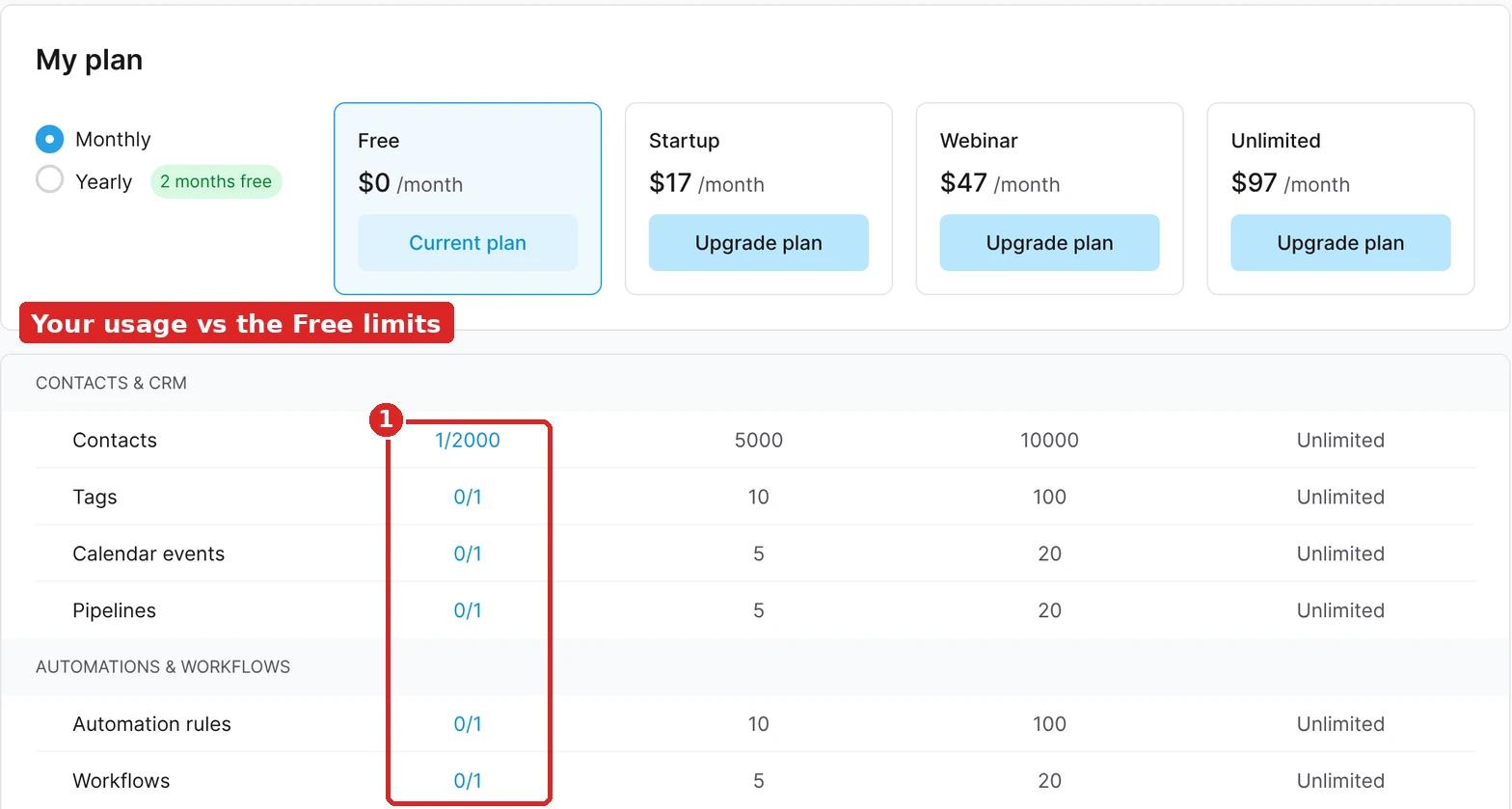
The My plan page in our free test account, captured November 20, 2026. The coach marks are ours.
Every Systeme.io free plan limit
| Feature | Free plan | Startup ($17/month) |
|---|---|---|
| Contacts | 2,000 | 5,000 |
| Emails sent | Unlimited | Unlimited |
| Newsletters (broadcasts) | Unlimited | Unlimited |
| Email campaigns (sequences) | 1 | 10 |
| Tags | 1 | 10 |
| Automation rules | 1 | 10 |
| Workflows | 1 | 5 |
| CRM pipelines | 1 | 5 |
| Sales funnels | 3 | 10 |
| Funnel steps | 15 | 50 |
| A/B tests | 1 | 10 |
| 1-click upsells / order bumps | 1 / 1 | 10 / 10 |
| Coupon codes | 1 | 10 |
| Courses | 1 | 5 |
| Students | 500 | Unlimited |
| Communities | 1 | 5 |
| Websites / blogs | 1 / 1 | 5 / 5 |
| Custom domains | 1 | 3 |
| Booking calendar events | 1 | 5 |
| Link-in-bio pages / products | 1 / 3 | 3 / 15 |
| Evergreen webinars | 0 | 0 |
| Sales revenue | $10,000 | Unlimited |
| Transaction fees | 0% | 0% |
The free plan also includes unlimited file storage, unlimited sub-accounts and assistant accounts, your own affiliate program, 24/7 email support, and the same payment gateways as paid plans. Evergreen webinars start on the Webinar plan ($47 per month).
The limit the pricing page does not show: $10,000 in sales
The public compare table lists 0% transaction fees on every plan but no revenue cap. Inside the account, the E-commerce & Sales section of the My plan page shows a sales revenue limit of 10,000 USD on Free and unlimited revenue on every paid plan.
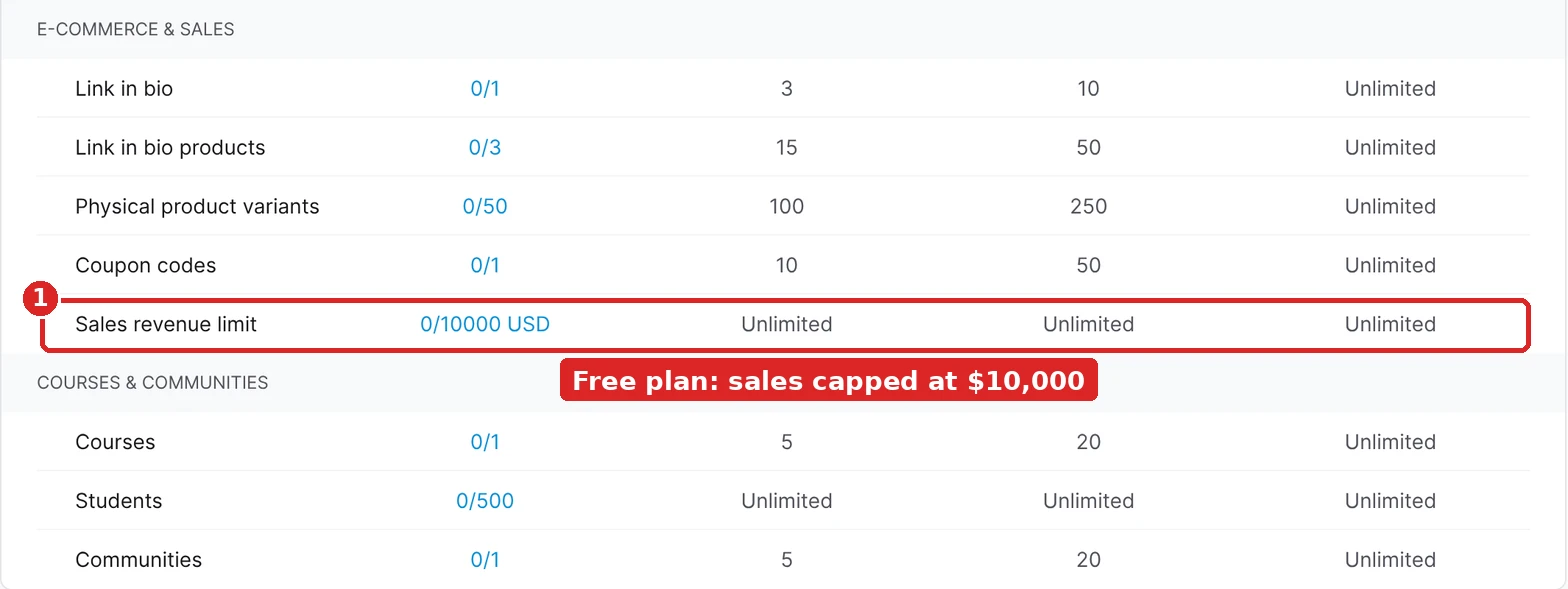
The revenue limit in our free test account, captured November 20, 2026. The coach mark is ours.
In practice, this means the free plan is a launchpad, not a long-term home for a business that sells. We did not reach the cap, so we cannot confirm exactly what happens at $10,000. Treat it as the point where you must be on a paid plan, and upgrade before a launch that could cross it.
Which free plan limit you will hit first
For most users, the order is:
- One email campaign. A campaign is an automated sequence. Free allows exactly one, which is enough for a welcome sequence. The moment you want a separate sales or onboarding sequence, you need Startup. One-off newsletters stay unlimited.
- One automation rule. One rule can tag new subscribers and add them to your sequence. It cannot also grant course access after a purchase, add a customer tag, and stop the sales sequence.
- One tag. With a single tag you cannot tell leads from customers, or separate subscribers from different lead magnets.
- 500 students. Course creators who give away a free mini-course hit this before the contact limit.
- $10,000 in sales. Successful sellers reach this next.
- 2,000 contacts. Usually last, unless you run paid traffic or a large giveaway.
If you mostly publish a newsletter and sell little, the free plan can last a long time. If you sell, plan on Startup within your first few launches.
How to get the most out of the free plan
- Use your one automation rule on the opt-in page. Trigger it with “Funnel step form subscribed” and subscribe new contacts to your welcome campaign. Our funnel setup guide shows the exact settings.
- Make your one campaign count. Write a welcome sequence that ends by introducing your offer, then use newsletters (unlimited) for everything else.
- Spend your three funnels deliberately. A lead magnet funnel, a sales funnel, and one spare is a sensible split.
- Verify a sender and authenticate your domain early. You cannot create a campaign until a sender is verified, and authenticating your domain helps delivery. Our getting started guide covers both steps.
- Watch the My plan page. Check it before a launch so a limit does not surprise you mid-campaign.
Common free plan mistakes
- Spending the one automation rule on the wrong page. If the rule is not on your opt-in page, new subscribers never reach your welcome sequence.
- Planning a second sequence before upgrading. Free allows one campaign, so a launch sequence on top of the welcome sequence needs Startup.
- Leaving the form button on the wrong action. Rules on a funnel page only fire when the button is set to Submit form.
- Sharing links on the default subdomain. Your default systeme.io subdomain is generated from your sign-up email address. Connect your one free custom domain before you share links.
- Ignoring the revenue cap during a launch. A strong first launch can approach $10,000 quickly, so check the My plan page beforehand.
When to upgrade, and what happens to your work
Upgrade to Startup when you need a second sequence, more than one automation rule, segmentation with tags, more than 500 students, or revenue above $10,000. Startup costs $17 per month, or $170 per year with annual billing (two months free). Upgrading happens from account settings, and you keep the funnels, contacts, and courses you built on Free.
If you later cancel, Systeme.io’s pricing FAQ says you keep the paid plan until the next billing date and then revert to Free, so anything above the free limits needs attention before that date. For every plan and limit side by side, see the Systeme.io pricing guide; for a stage-by-stage decision, see Systeme.io free vs paid plans.
Start on the Systeme.io free plan and build one funnel, one sequence, and one rule before deciding whether to upgrade.
FAQ
Is the Systeme.io free plan really free forever?
Yes. Systeme.io says the free plan never expires and does not require a credit card. You can stay on it indefinitely as long as you stay within its limits: 2,000 contacts, three funnels, one email campaign, one automation rule, one course with up to 500 students, and $10,000 in sales.
Does the Systeme.io free plan limit how many emails I can send?
No. Email sends are unlimited on every plan, including Free, and so are one-off newsletters. The free plan limits automated sequences (one campaign), automation rules (one), and tags (one), which is what usually pushes active email marketers to Startup.
Can I sell products on the Systeme.io free plan?
Yes. You can connect Stripe, PayPal, and other gateways and sell through order forms with 0% transaction fees from Systeme.io. The free plan includes one order bump and one upsell, and the in-app plan page caps total sales revenue at $10,000 before a paid plan is required.
Can I host a course on the Systeme.io free plan?
Yes. The free plan includes one course with up to 500 students, plus one community. Paid plans raise the course count to 5, 20, or unlimited and remove the student cap entirely, which matters if you use a free course as a lead magnet.
What is the cheapest way to get more than the free plan?
Startup at $17 per month, or $170 per year on annual billing, raises contacts to 5,000, campaigns, rules, and tags to 10 each, funnels to 10, and removes the student and revenue caps. For most solo creators it is the only upgrade they need for a long time.