MarketingGuide
Systeme.io for Small Business Marketing (Honest Fit)
How small businesses use Systeme.io for marketing: funnel-led workflows, features that matter, honest limits, and when HighLevel or vertical tools fit better.

Small business marketing used to mean a website, a Facebook page, and occasional email blasts. Today it means capture pages, nurture sequences, booking links, reminders, and sometimes checkout—often spread across four subscriptions nobody fully adopted. Systeme.io for small business marketing bundles funnels, email, automation, and payments under one login at prices that undercut assembled stacks. That bundle helps many solos and micro-businesses. It is not the right default for every local shop, agency, or inventory-heavy retailer.
This use-case guide covers SMB marketing workflow fit, features worth prioritizing, the plan each stage needs, honest limits, and when to compare alternatives. Features and limits were checked on Systeme.io’s pricing page and in a free account we tested on November 20, 2026. For pricing tables and competitor context, read Systeme.io review, Systeme.io pricing, and best all-in-one marketing platform.
The small business marketing loop
Most SMBs under twenty employees repeat a recognizable digital loop—even when execution is messy:
Attract — Local SEO, referrals, ads, or community visibility drive traffic.
Capture — Visitor opts in, requests quote, or registers for offer.
Nurture — Email (sometimes SMS) establishes trust before purchase.
Convert — Checkout, booking link, or sales conversation closes deal.
Retain — Thank-you, review ask, rebook or upsell sequence.
Refer — Affiliates, word-of-mouth, and reputation feed next cycle.
Systeme.io maps cleanly when capture through convert happens online with email as primary channel. It strains when marketing depends on dispatch handoffs, heavy two-way SMS, or multi-location phone operations—patterns where HighLevel or vertical SaaS often fit better.
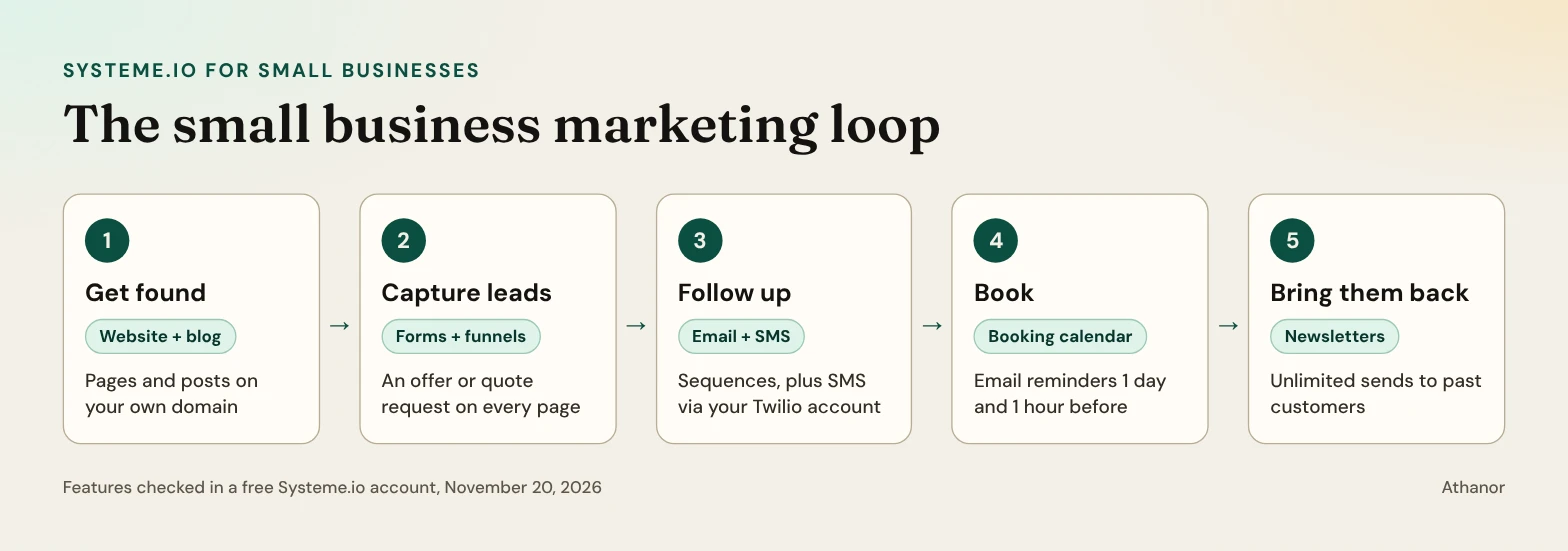
Illustration by Athanor, based on features checked in a free Systeme.io account on November 20, 2026.
Where Systeme.io fits small business marketing
Strong fits
Solo service professionals selling expertise. Consultants, trainers, tutors, and local professionals running workshop → nurture → booking funnels get leverage without CRM enterprise weight.
Digital and hybrid offers. Ebooks, mini-courses, membership communities, and payment-plan programs benefit from bundled checkout and course hosting—capabilities listed on Systeme.io’s official site.
Budget-first validation. The free plan never expires and includes 2,000 contacts, three funnels, a website, and one custom domain; Startup is $17/month for up to 5,000. Test one complete funnel before committing to $97/month stacks.
Owners who will ship one funnel end-to-end. Systeme.io rewards operators who launch imperfect pages quickly—not teams that configure every module before first lead arrives.
Affiliate-led growth. Built-in affiliate management helps SMBs recruit partners without a fourth tool when referral economics matter.
Compare bundle value against point solutions in best marketing automation for small business once one funnel proves conversion.
Weak fits (be honest)
Multi-staff local shops with dispatch complexity. Plumbers, HVAC crews, and multi-chair salons needing unified SMS inboxes, technician handoffs, and show-rate reporting often outgrow Systeme.io’s CRM depth—see best CRM for local service businesses.
Agencies managing many client brands. Systeme.io does include unlimited sub-accounts on every plan and a white-label offering, but it is built for businesses marketing their own offers. Agencies that need two-way SMS and calling, reputation management, and client rebilling usually fit HighLevel better—read HighLevel for marketing agencies.
Inventory-heavy e-commerce. Large catalogs, complex shipping rules, and deep cart automation exceed Systeme.io’s center of gravity.
Teams needing telecom-first local automation. SMS reminder volume, missed-call text-back, and reputation workflows tied to appointment completion may require telecom-rich platforms—evaluate SMS scope in Systeme.io review against how to automate appointment reminders.
Design-obsessed brands. Template-first pages are functional, not Webflow-flexible. Premium visual control may require separate site tools.
Systeme.io is a pragmatic SMB marketing stack—not a universal small business operating system.
Features that matter for SMB marketing
Not every module deserves day-one attention. Prioritize these:
Funnel and page builder. Opt-in pages, sales letters, and webinar registration without a separate landing-page subscription. Speed beats pixel perfection for most SMB offers.
Email marketing and automation. Tag on opt-in source, branch on link clicks, stop sequences on purchase. Unlimited sends on published paid tiers remove contact anxiety common on entry ESP plans.
Checkout and payments. Sell services, programs, and payment plans where supported—pair with Stripe or PayPal per official documentation.
Contact management, tags, and pipelines. Kanban CRM pipelines (1 on Free, 5 on Startup, 20 on Webinar) track leads through custom stages; sufficient for many SMB nurture paths, not equivalent to multi-rep forecasting.
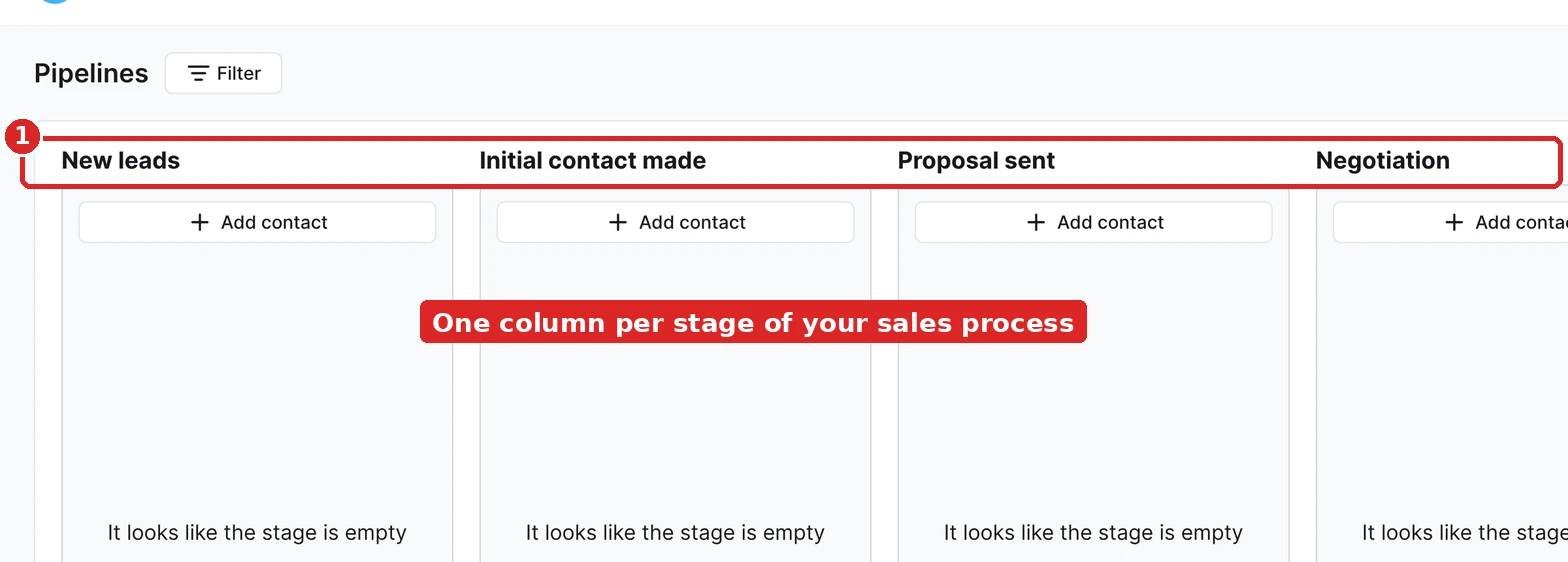
A new pipeline board in our test account, captured November 20, 2026. The coach mark is ours.
Booking calendar. Clients pick a slot, get confirmation emails, and can pay a deposit or full fee at booking, with Google Calendar, Meet, and Zoom integrations. Free includes one event type, Startup five. When we created a test event, Systeme.io offered individual or group events, locations of Zoom, Google Meet, in person, phone, or an external link, booking rules (minimum notice, cancellation deadline, daily limit, and buffer time), and two email reminders by default. SMS reminders need your own Twilio account.
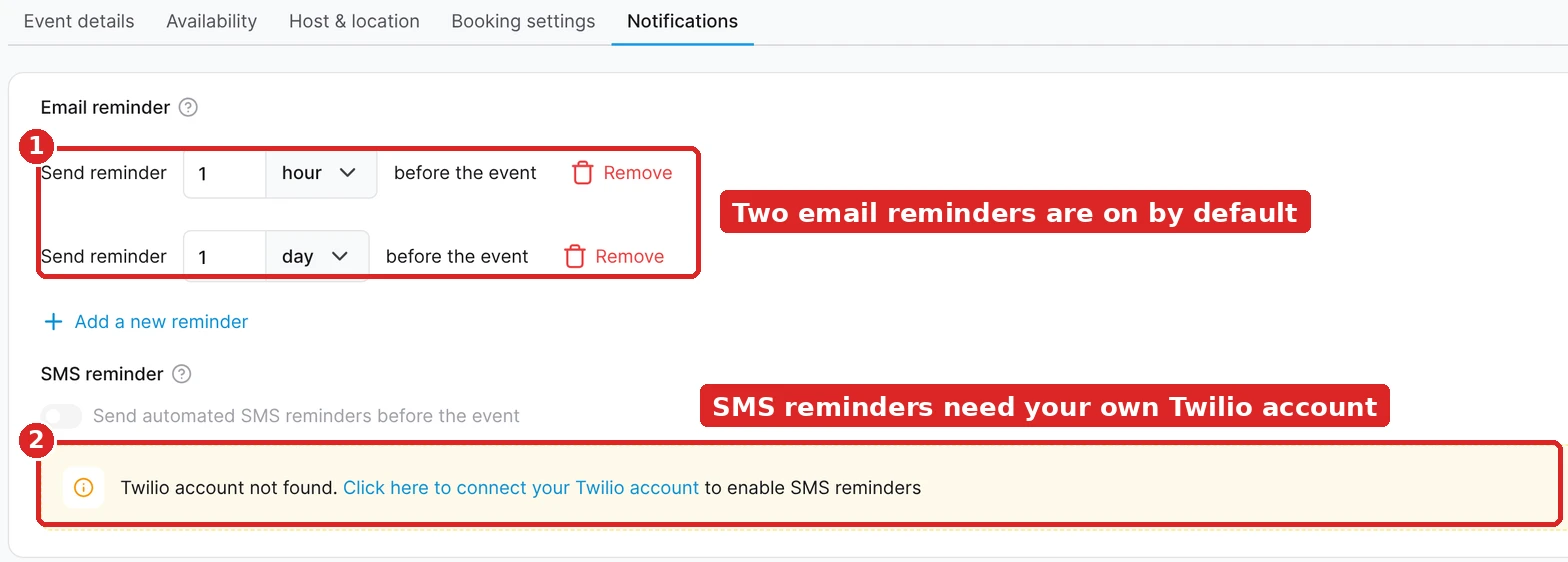
Reminder settings for a test booking event, captured November 20, 2026. The coach marks are ours.
SMS. SMS templates, statistics, and SMS actions in automations are available on every plan, but messages are sent through your own Twilio account, connected under Integrations, and Twilio bills you per message. Booking SMS reminders also need Twilio connected; email reminders work without it.
Blog (optional). Local SEO supporting long-tail discovery—secondary to email for many shops but included.
Webinar and event patterns. Registration → reminder → replay offer is a native use case when events drive leads; evergreen webinars start on the Webinar plan ($47/month).
Order bumps and upsells. Increase average order value at checkout without cart plugins when offer stack stays simple.
Everything sits under one top menu, which is a large part of the appeal for owners who do their own marketing:
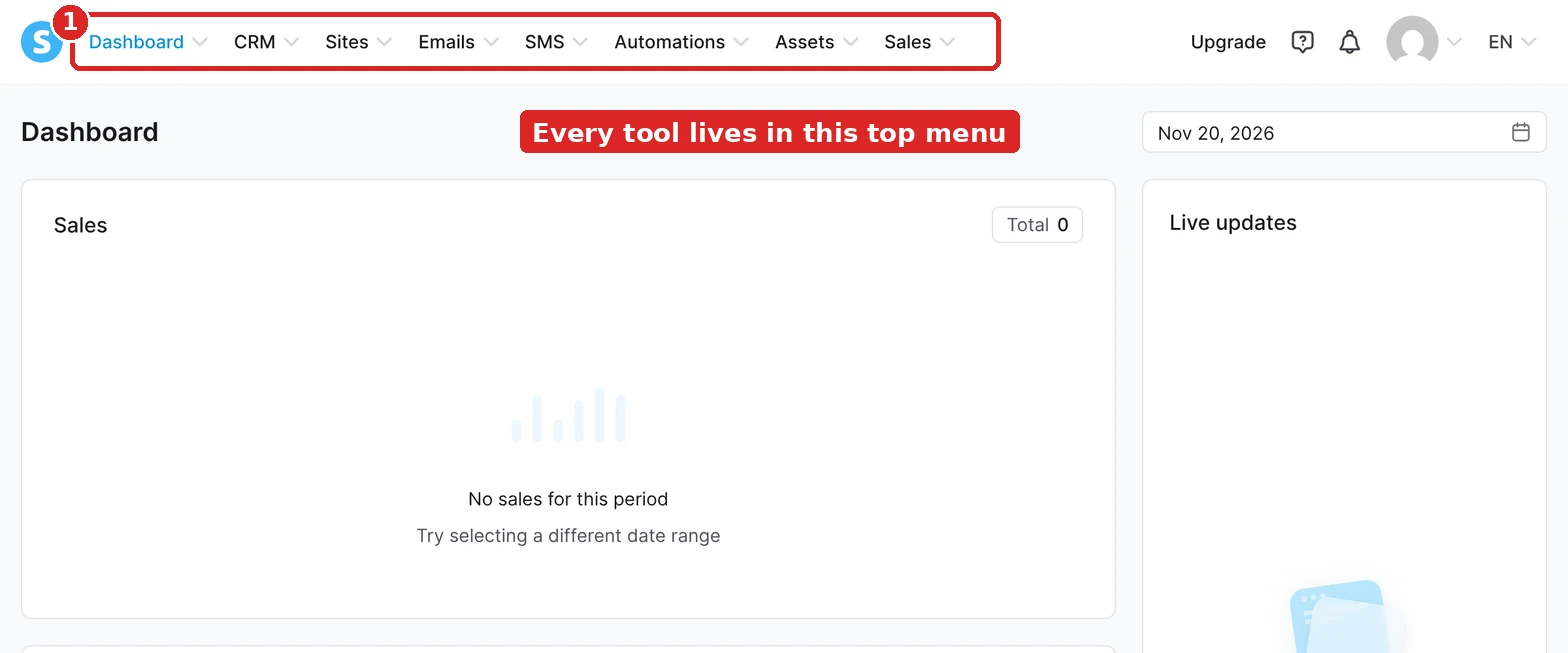
The dashboard of our free test account, captured November 20, 2026. The coach mark is ours.
Deep feature evaluation: Systeme.io review. Tier limits: Systeme.io pricing.
Which plan a small business needs
| Stage | Plan | Why |
|---|---|---|
| Testing one funnel, under 2,000 contacts | Free | Website, 3 funnels, 1 sequence, 1 automation rule, 1 booking type |
| Running lead, booking, and buyer workflows | Startup ($17/mo, $170/yr) | 10 sequences and rules, 5 booking types, 5 pipelines, unlimited revenue |
| Webinars or 5,000–10,000 contacts | Webinar ($47/mo) | Evergreen webinars, 20 booking types, 100 rules |
| Several brands or over 10,000 contacts | Unlimited ($97/mo) | No limits |
The workflows below need several automation rules and sequences, which is why most small businesses run on Startup. On Free, the in-app plan page also caps sales at $10,000.
Open a free Systeme.io account and move to Startup when your second workflow goes live.
SMB marketing workflows to build first
Ship these before advanced segmentation.
1. Lead magnet → welcome sequence. Deliver asset, introduce offer, invite to booking or checkout within five to seven emails.
2. Abandoned checkout or incomplete application. One reminder at twenty-four hours, one at seventy-two hours, then stop.
3. Post-purchase onboarding. Thank-you, how to get value, support contact, referral invite.
4. Re-engagement for cold list. Quarterly three-touch win-back for contacts with no open in ninety days—suppress recent buyers.
5. Event registration reminders. Mirror appointment reminder logic for webinars—confirmation, twenty-four-hour nudge, replay link.
Local appointment-heavy shops should pair email nurture with reminder discipline—marketing automation for local businesses covers when Systeme.io versus HighLevel fits.
Try Systeme.io free to test one complete funnel against your next launch timeline.
Limits to know before you commit
Enter with eyes open—limits are scope boundaries, not hidden flaws.
CRM depth. Tags and contact history suffice for many SMBs; multi-rep sales teams with complex pipelines may need HubSpot or HighLevel later.
Contact tier gates. Free: 2,000 contacts; Startup $17/month: 5,000; Webinar $47/month: 10,000; Unlimited $97/month: unlimited. Free also caps sales at $10,000 on the in-app plan page.
Integration scope. Native integrations cover Google Sheets, Google Calendar, Google Meet, Zoom, ActiveCampaign, SendGrid, and Twilio SMS; other tools connect through webhooks or the public API.
SMS and local telecom. SMS runs through your own Twilio account, and there is no two-way business texting inbox or calling like telecom-native platforms offer.
Deliverability responsibility. Authenticate domains, warm sending reputation, write copy that earns opens—platform does not replace discipline.
Migration cost. Leaving means rebuilding automations and access rules. Export contacts, document tag meanings, plan quiet-week cutover.
Support and learning curve. Non-technical owners succeed when they ship one funnel before enabling every module.
When limits bite, upgrade paths are usually HighLevel for local/agency ops or Kajabi for premium course brands—compare total cost before incremental point tools.
Systeme.io vs HighLevel for SMB marketing
| Question | Lean Systeme.io | Lean HighLevel |
|---|---|---|
| Primary channel | Email nurture | SMS + email |
| Team size | Solo or micro | Staff handoffs |
| Locations | One brand | Multi-location |
| Budget floor | $0–$17/month entry | $97/month Starter |
| Agency clients | Rarely | Often |
The dividing line is the channel. If your customers find you online and buy after reading emails, Systeme.io does the job for a fraction of the cost. If your business runs on phone calls, text conversations, reviews, and appointments handled by staff, HighLevel’s telecom and inbox tools justify its $97 starting price plus usage fees. See HighLevel vs Systeme.io for the full comparison. Neither wins absolutely—fit beats rankings. Best all-in-one marketing platform frames the strategic tradeoff when consolidation is the goal.
FAQ
Is Systeme.io good for small business marketing?
Yes, for solos and micro-businesses that market online with funnels, email nurture, booking, and digital offers on a budget. It is a weaker fit for multi-staff local dispatch, agencies serving many clients, or businesses that depend on two-way texting and calling.
How much does Systeme.io cost for SMBs?
Free $0 (2,000 contacts, $10,000 sales cap), Startup $17/month or $170/year (5,000), Webinar $47/month or $470/year (10,000), and Unlimited $97/month or $970/year (unlimited). Email sends are unlimited on every plan. See Systeme.io pricing for funnel, booking, and course limits.
Can local service businesses use Systeme.io?
Consultative and workshop-led local professionals, yes: the booking calendar can take paid appointments and the website, email, and SMS cover marketing. Appointment-heavy shops with technician handoffs or two-way texting should compare best CRM for local service businesses before committing.
When should SMBs switch from Systeme.io?
When two-way SMS and calling, a shared team inbox, reputation management, or multi-location operations become requirements—not when one email sequence underperforms. Test copy and offer before blaming the platform, and check whether upgrading within Systeme.io solves the limit first.
Systeme.io vs Mailchimp plus landing page tools?
Systeme.io consolidates pages, email, and checkout—lower login count and often lower combined cost. Mailchimp may win on mature deliverability history; see when to move from Mailchimp to all-in-one if debating migration.
Systeme.io fits small business marketing when the operator wants one affordable stack to capture, nurture, and sell online while proving economics. It is weaker when CRM complexity, agency delivery, telecom-first local ops, or large e-commerce catalogs dominate. Start on the free plan, ship one complete funnel, then use the Systeme.io review and pricing vs value guides when you outgrow the basics.
Start free on Systeme.io — one stack for capture, email, and checkout